
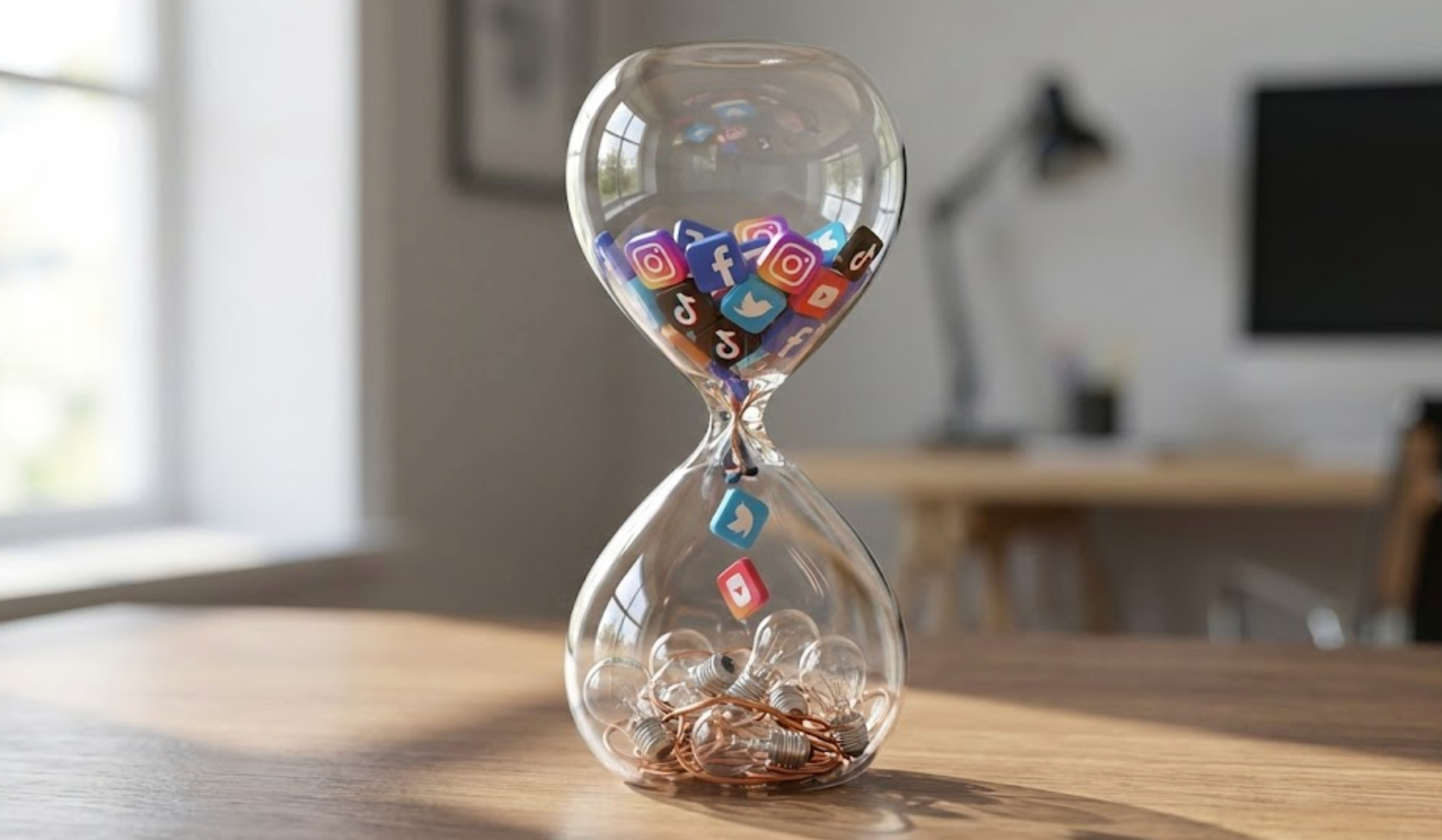
I was waiting to join a Zoom call last week, and surprisingly—even to myself—I had a few minutes to spare. Not because I'm particularly busy, but because I'm terrible at time management.
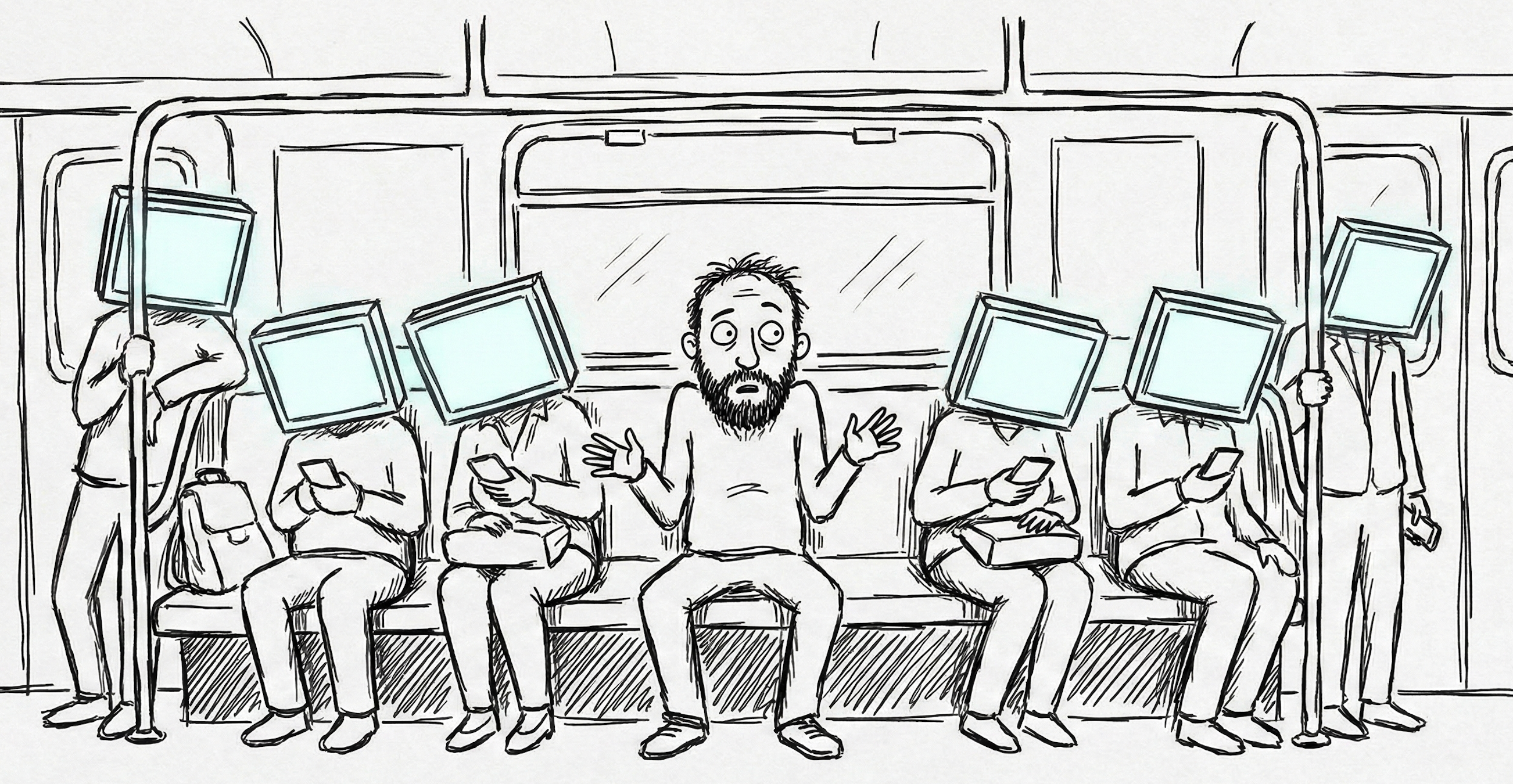
I instinctively reached for my phone. No conscious decision. Unlock, check a notification, refresh email. There was nothing to check, but I still did. Sadly it's not just me. A single bus or subway ride, away from our screens, shows how deeply stuck we are. Airports and waiting rooms are quieter now, just rows of people locked into their screens. Two people waiting together aren't talking—they're parallel-scrolling. We've collectively developed an allergy to waiting. Boredom has become a void that demands immediate filling.
I've been wondering if we've got the whole thing backwards.
Yashraj Sharma wrote about how our obsession with speed—What We Get Wrong About Breakthroughs—is rewiring our expectations of reality. It got me thinking about what's actually happening inside our heads.
When we're not actively doing something, the brain doesn't sit idle. Neuroscientists call it the Default Mode Network. The brain runs a background workshop connecting random thoughts, processing memories, generating those shower-thought breakthroughs we crave.
Turns out we don't need to waste water taking long showers to find more Eureka moments.
Every time we fill a 30-second gap with screen time, we're essentially interrupting that process. Trading synthesis for noise.
The Research
In 2014, researchers Sandi Mann and Rebekah Cadman at the University of Central Lancashire ran an experiment. They split participants into two groups. One had to copy phonebook entries for 15 minutes, the other jumped straight into a creative task.
When both groups were asked to brainstorm uses for plastic cups, the bored group significantly outperformed. Their brains, starved of stimulation, had renewed energy for the task at hand.
But here's what's interesting: they ran a follow-up. This time, one group read the phonebook instead of copying it. Even more passive. Even more boring.
That group performed best of all.
It seems the more passive the boredom, the more the mind wanders. More creative fuel gets generated. Even if we curate our feeds and limit screen time to drown out the noise, we still need further downtime. Space for the brain to form connections, to absorb, reflect, and understand what it already knows.
Boredom isn't wasted time. It's the setup.
To make matters worse, we've raised our dopamine baselines. Normal activities—reading, sitting quietly, watching water boil—feel unbearably slow because we've recalibrated for constant, high-frequency input.
Kids are made to build focus through unstructured play, manufacturing their own entertainment. Now everything's programmed stimulation. We're not just filling gaps anymore. We're eliminating the breathing room our brains need to process anything before jumping to the next thing.
Focus takes years to build, and only weeks to destroy.
And the system is working against us by design. Our idle moments are someone's revenue opportunity. The attention economy has made empty time a market inefficiency to be captured.

Finding Boredom
I've been experimenting with what I think of as "transitional boredom"—those in-between moments that used to be natural gaps. The walk from my car to the building. Waiting for my tea to brew. The elevator ride. These used to be dead space. Now they're content consumption windows.
I'm actively forcing myself to abstain from devices during certain stretches. No podcast on short commutes. Phone in another room during work times and meals. It's harder than it sounds—I constantly feel an itch that takes a few minutes to settle.
I'm not sure I can even tolerate boredom the way I could. The muscle might have atrophied. Sitting still for five minutes without input feels less like rest and more like resistance training.
I don't have a prescription here. Everyone's relationship with stimulation is different, and performative boredom sounds exhausting.
Here is a question for you,
If you wanted to be bored, how would you do it? Is there a stretch of your day you've protected from input, or do you reset your brain in a different way?
Write to us at plainsight@wyzr.in. We’ll include the most thoughtful answers in next week’s edition.
Subscriber Spotlight
The AI Architect shared his view on Utkarsh’s piece, Of Breads and Circuses:
“Sharp take on how exhaustion breeds simplification. The Weimar parallel is unsettling but the feedback loop framing adds something crucial that most analysis misses. I've seen this in corporate change management where prolonged problem fatigue makes people hungrier for enemies than explanations. The real discomfort is recognizing how we're all complicit in rewarding the distracion when nuance feels like too much work.”
What we are reading at Wyzr
Reshuffle by Sangeet Paul Choudhary. Having read a couple of recent releases around AI, this book offers a fresh perspective—not the usual doom-or-revolution take. Understanding AI's evolution requires thinking across multiple levels, and this book broadens your view of how AI affects business and society.
Until next time.
Best,